Back to Solutions

Solution

For Dashboard Builders and BI Prototyping

Create dashboard test data with relational integrity and time-evolving behavior so chart validation, filters, and client demos feel production-ready.

Use-case playbook

Problem

  • Charts look correct with toy data but break with realistic distributions.
  • Filter, grouping, and join behavior is hard to validate with flat fixtures.
  • Client demos need separate datasets without duplicating setup effort.
  • Teams need to test edge cases before handing work to engineering.

How Synthbrew helps

  • Generate time-evolving relational mock data for realistic chart behavior.
  • Keep joins and constraints intact across entities and dimensions.
  • Create multiple sources from one schema for isolated demo environments.
  • Reproduce edge cases consistently with deterministic generation controls.

Why this beats static mocks

  • Spreadsheet data does not reflect relational constraints in runtime queries.
  • Random generators rarely preserve consistent cross-table relationships.
  • Flat fixtures hide chart and aggregation issues until late testing.

Validate dashboards with data that behaves like real operations

BI and dashboard prototypes often fail when they leave the design stage because the data behind them was too simplified. Synthbrew gives teams realistic relational datasets that evolve over time, so chart behavior and interaction logic can be validated under practical conditions.

This is especially useful when teams need to prove that filters, groupings, and multi-table joins hold up before production pipelines are available.
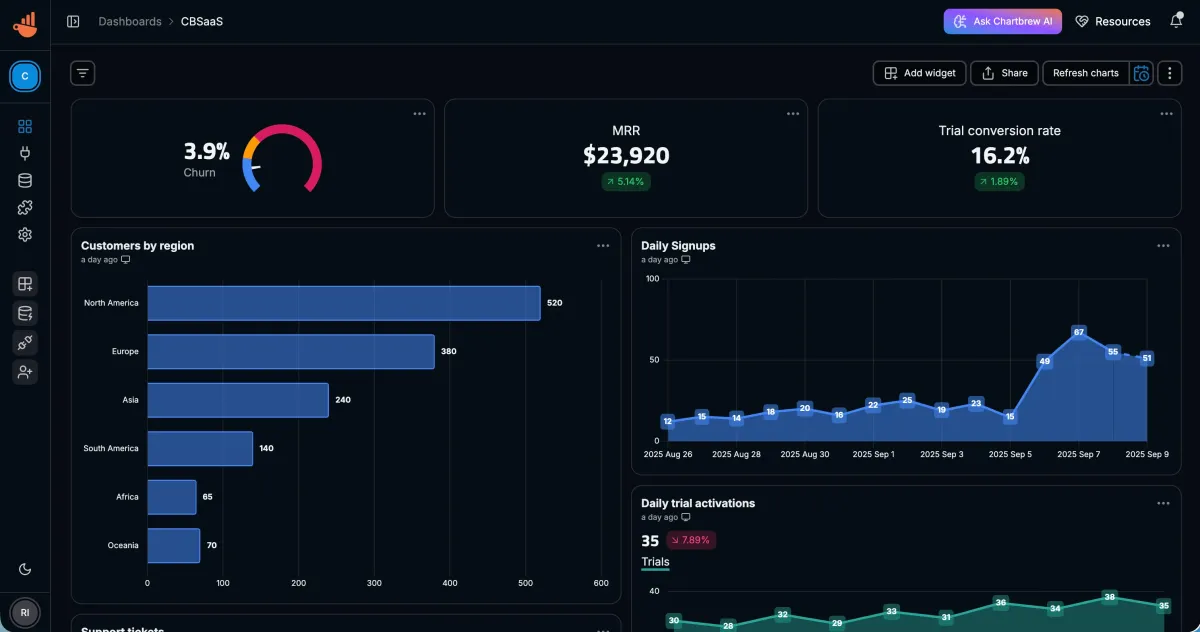
Demo dashboards

Give each client or stakeholder an isolated demo environment

With Synthbrew, teams can spin up independent sources per demo while preserving shared schema structure. That means agencies and BI teams can show tailored scenarios without contaminating a single shared dataset.

It also makes feedback rounds cleaner because each environment has predictable data history and state.

Move from “looks good” to “works under real constraints”

When dashboard prototypes are backed by relational mock data and persistent APIs, teams can catch data-shape issues sooner and make decisions with higher confidence. The result is faster iteration and fewer late surprises once backend integration starts.

See more use cases on Solutions and plan options on Pricing.

Ready to replace static mocks with a real backend?

Use this playbook as your starting point, then compare other solution tracks or plan limits for your rollout.