Back to Solutions

Solution

For API-First Prototyping Teams

Prototype against a real Postgres connection and secure CRUD API with API keys per source so auth, pagination, caching, and client-side logic can be tested properly.

Use-case playbook

Problem

  • Client apps need realistic API behavior before production services exist.
  • Auth, pagination, and caching logic are hard to validate on static mocks.
  • Teams need persistent state to test mutation-heavy flows.
  • Backend simulation quality determines prototype credibility.

How Synthbrew helps

  • Connect through real Postgres access on supported plans.
  • Use secure CRUD API endpoints scoped by source API keys.
  • Regenerate deterministic datasets for repeatable integration tests.
  • Validate pagination, caching, and auth-adjacent flows with confidence.

Why this beats static mocks

  • Most mock tools do not provide persistent relational backend state.
  • Fake handlers rarely expose real API constraints under load.
  • Static fixtures do not model evolving source data over time.

Prototype like you are integrating with a real backend

API-first teams need more than sample payloads. They need a backend simulation that supports real requests, persistent data behavior, and source-level access controls. Synthbrew provides this through runtime CRUD APIs and optional read-only Postgres access.

That makes early integration work more trustworthy and reduces the gap between prototype and production architecture.
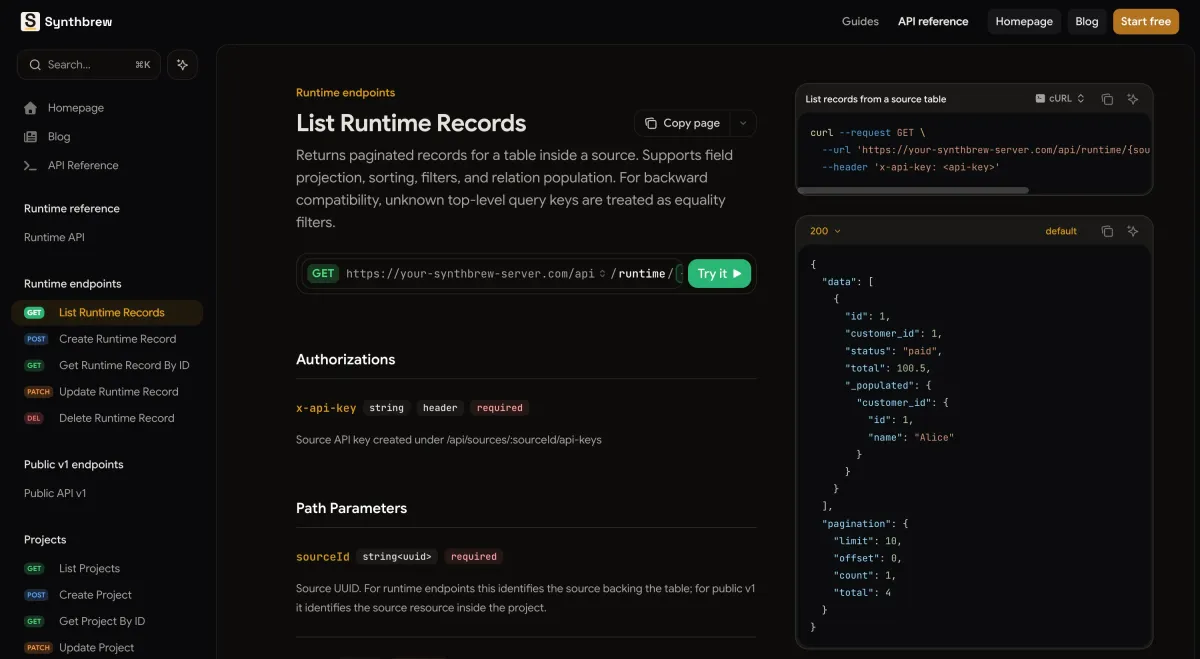
API docs

Test the logic that usually breaks at integration time

Pagination, client-side caching, and state synchronization issues are rarely caught with static mock files. Synthbrew helps teams validate these behaviors under realistic conditions because data can mutate, persist, and regenerate predictably.

This improves release confidence by surfacing integration risks earlier.

Build prototypes that can survive the handoff to production

When the prototype already uses a realistic API and relational dataset, backend handoff becomes cleaner. Teams spend less effort rewriting assumptions and more time hardening workflows that are already validated.

See additional use-case playbooks on Solutions and available limits on Pricing.

Ready to replace static mocks with a real backend?

Use this playbook as your starting point, then compare other solution tracks or plan limits for your rollout.