Stable contracts across environments
Publish immutable schema versions so development, QA, and staging each run against a trusted, explicit data contract.
Feature
Design relational schemas visually, publish immutable versions, and pin each source to a stable contract so frontend and backend delivery stay aligned.
Publish immutable schema versions so development, QA, and staging each run against a trusted, explicit data contract.
Pin every source to a specific schema version, then move to new versions on your timeline instead of breaking active flows.
Keep seeded data and integration work aligned with versioned schemas to reduce rework, flaky tests, and release regressions.
When product teams move quickly, data contracts often change faster than implementations can keep up. A schema-first workflow keeps everyone aligned by turning your data model into a concrete source of truth before runtime code branches in different directions.
Synthbrew lets you model entities and relationships visually or start from an AI-assisted draft, then evolve that model with explicit version control. Instead of relying on shared assumptions, your team can work against a published schema artifact that stays stable for each environment.
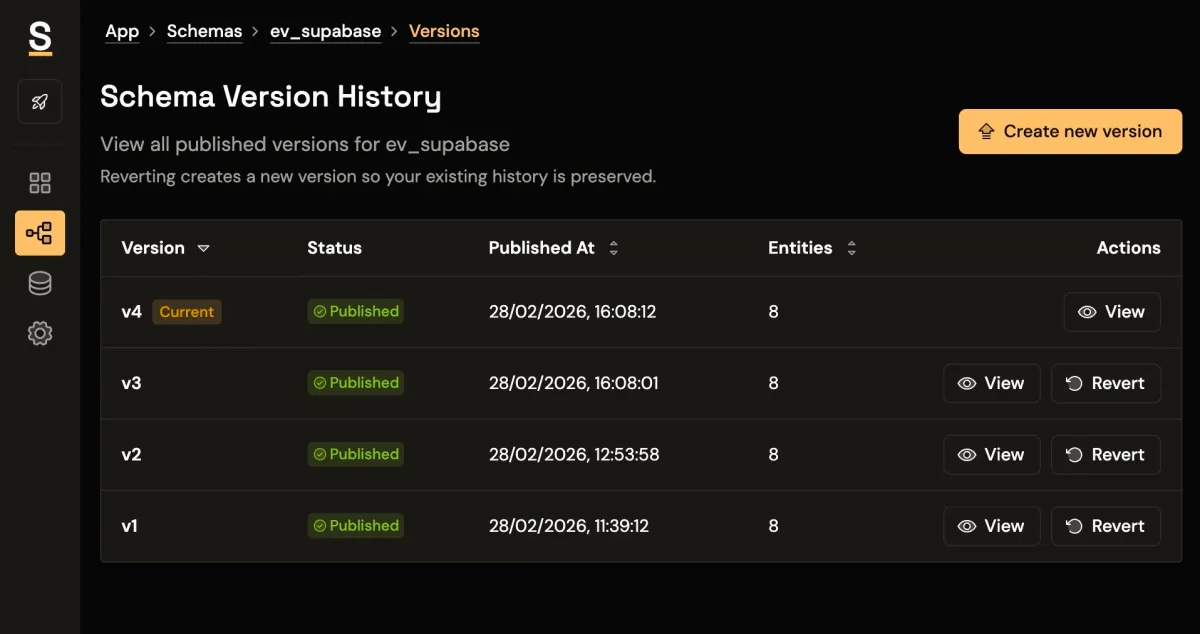
Mutable schemas are convenient early on but expensive later. Once QA, demos, and staging all depend on specific fields and relationships, silent changes create regressions that are hard to trace. Immutable versioning solves that by making each published schema a fixed reference point.
With versioned schema management, you can introduce changes in a controlled way. Existing sources keep running on the version they already trust, while new sources can adopt the next version when your team is ready. This reduces accidental breakage and improves confidence during release planning.
A common rollout pattern starts with a baseline schema pinned across development and QA. Product teams iterate on UX, QA validates seeded scenarios, and engineering can prototype integrations against stable contracts. When requirements shift, a new schema version is published and tested in parallel rather than replacing the old contract immediately.
This approach is especially useful when frontend development needs to continue before backend APIs are finalized. You maintain compatibility for in-flight work while still unlocking change.
Schema modeling and immutable versions shorten the feedback loop between planning and execution. Teams spend less time repairing mismatched fixtures, less time reworking test flows, and less time revalidating already-approved product behavior after every data-model change.
The outcome is practical: faster implementation cycles, cleaner QA handoffs, and more predictable releases when multiple teams contribute to the same product surface.
For implementation details, explore the full features overview or compare rollout limits on pricing.
Use this playbook as your starting point, then compare other solution tracks or plan limits for your rollout.