Prompt-to-schema creation
Describe your domain in natural language and turn it into a structured schema draft that is ready for refinement and versioning.
Feature
Generate relational schemas from AI prompts or existing database definitions so teams can onboard faster and keep schema design aligned with real systems.
Describe your domain in natural language and turn it into a structured schema draft that is ready for refinement and versioning.
Start from current table structures instead of rebuilding schema design manually, which reduces migration friction and setup time.
Move from model idea to seeded data generation quickly by standardizing how new schemas are created across teams.
Teams often lose days translating product requirements into initial table structures. AI and database definition import reduce that setup overhead by converting intent or existing structure into a working schema draft inside Synthbrew.
This helps teams begin with practical defaults and iterate from a concrete model rather than starting from an empty editor.
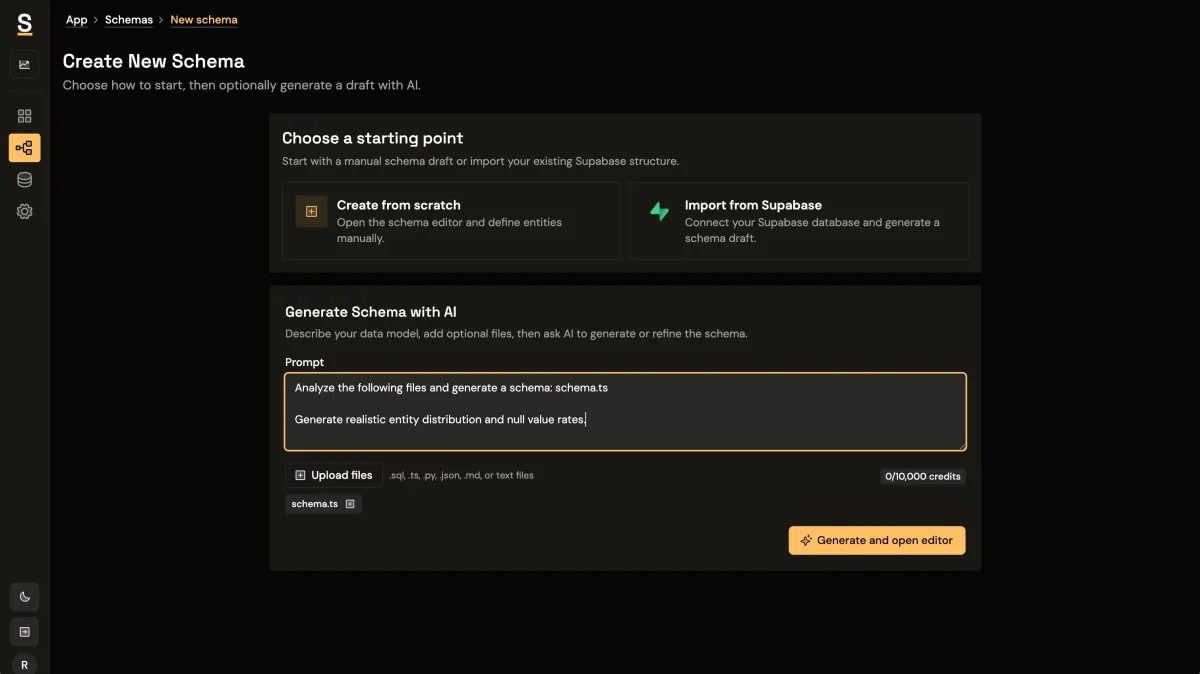
When product requirements are still evolving, prompt-driven schema drafting gives teams a quick way to test different model shapes. You can refine relationships, field types, and naming conventions after generation while keeping momentum during early planning.
The result is faster validation of data-model assumptions before deeper implementation work begins.
If you already have a production or staging database design, importing existing definitions prevents duplicate modeling work. Teams can align synthetic data workflows with real-world structures and reduce mismatches between testing environments and operational systems.
This is especially useful for modernization projects where data quality and schema parity matter from day one.
Schema creation becomes a repeatable onboarding step instead of a bottleneck. Product teams can model faster, engineering teams can standardize setup across projects, and QA teams can validate seeded datasets against more realistic structures earlier in the release cycle.
For related capabilities, explore the complete features overview or compare plan limits on pricing.
Use this playbook as your starting point, then compare other solution tracks or plan limits for your rollout.